
Desalination plant site
A Multi-Criteria Analysis compared two potential site locations– Mullaquana Station and Cape Hardy, on the eastern Eyre Peninsula.
Mullaquana Station, located approximately 20km south of Whyalla, is the confirmed site for the Northern Water desalination plant, following comprehensive environmental, engineering and socio-economic investigations.
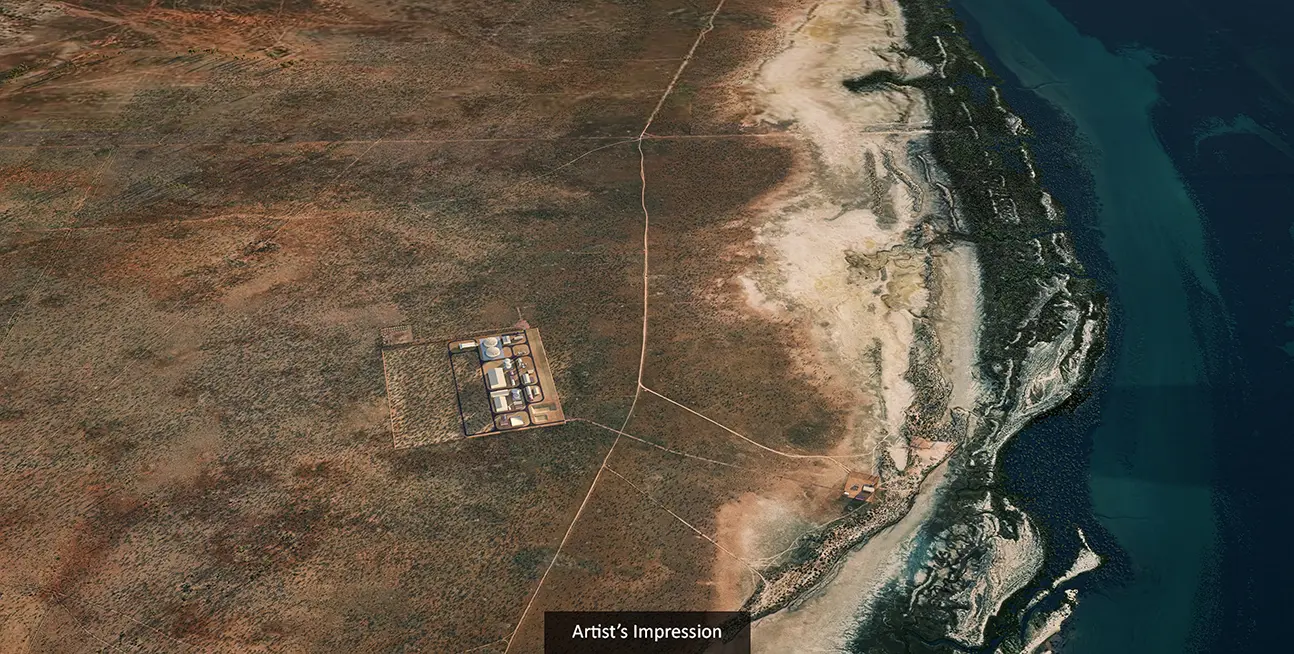
Image: Artist's impression of desalination plant as viewed from above.
Selecting Mullaquana Station as the site for the desalination plant is an important milestone for the delivery of Northern Water.
Mullaquana Station was selected for the following reasons:
- Meets strategic Project objectives – Locating the desalination plant at Mullaquana Station enables the supply of water closer to demand in the Upper Spencer Gulf and Far North.
- Greater economic and financial viability – The desalination plant and transfer pipeline will be more cost effective to build and operate due to the plant’s proximity to available workforce, local industry and existing transport infrastructure (newly redeveloped airport, rail and port facilities) and the pipeline’s proximity to water demand.
- Favourable construction environment – On and offshore geotechnical investigations found that the ground conditions at Mullaquana Station are predominantly clay, making it favourable to construct the desalination plant and establish underground pipelines / tunnels.
- Supports growth in Whyalla and the region – Mullaquana Station is closer to potential water users, industry, workforce and infrastructure, aligning favourably with the State’s aspirations to grow the economy of the Upper Spencer Gulf and Far North.
- Lower estimated greenhouse gas emissions – The final desalination plant being at Mullaquana Station will mean lower greenhouse gas emissions and reduced operational energy consumption.
Pipeline corridor
Development of the proposed transfer system pipeline corridor included extensive engagement and negotiation with Traditional Owners, specifically the Kokatha and Barngarla peoples, as well as pastoral landholders, leaseholders and relevant government agencies. Feedback from this process, together with Aboriginal cultural heritage surveys and terrestrial investigations, informed refinements to the proposed corridor alignment.