
The process of desalination involves turning seawater into water that is suitable for many uses, including use in industrial processes and as potable drinking water. Northern Water’s primary purpose is to supply water suitable for industrial use.
How desalination works
Desalination works by pumping seawater at high pressure through a semi-permeable membrane, which traps salt and other impurities while allowing fresh water to pass through. The remaining return water, sometimes referred to as brine, is then returned to the ocean where it disperses quickly.
There are many steps in the process, which you can explore below.

Seawater intake
Seawater enters the intake several kilometres offshore in deep water. The low velocity of the water entering the intake allows marine life to swim in, out and around the structure.

Pre-treatment: screening and filtration
Debris and larger particles, such as sediment, are filtered out to ensure the seawater is clean enough for the next step in the desalination process.
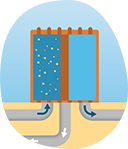
Reverse osmosis
The filtered seawater is pumped at high pressure through a membrane, separating fresh water from the seawater. The membrane pores are so small that salt cannot pass through.

Post-treatment: stabilise water
Minerals, including carbon dioxide and lime, are added to the desalinated water to balance pH levels and stabilise the water.

Water supplied to industry
A system of underground pipelines, pump stations and water storages transfers desalinated water to industry and wholesale customers.

Seawater outfall
About half of the water from the process is returned to the Gulf through an outfall and diffuser system located several kilometres offshore in deep water.
The return water is discharged at high velocity, allowing it to mix and disperse rapidly and return the marine environment to natural salinity levels.
Desalination then and now
Efforts to purify water through desalination date back to ancient times, with the earliest known attempts made by the Ancient Greeks and Romans around 500 BCE.
Greek sailors boiled seawater to separate out salt, while the Romans trapped salt using clay filters. Modern desalination methods continue to draw on these same principles of distillation and filtration.
In 1869 one of the earliest modern, large-sale desalination plants was built in Egypt to provide fresh water to steamship crews and passengers passing through the Suez Canal.
Closer to home, a disused desalination plant and water tower - once used to supply fresh water for the Ghan’s steam engines - still stand beside the old rail line at Curdimurka on the Oodnadatta Track.
Today there are approximately 23,000 desalination plants in more than 170 countries. Combined, these desalination plants produce an estimated 95 million cubic metres of freshwater each day.